



On August 1, 2026, the EU put the third transition-stage filing requirements of CBAM into full operation for steel and structural steel exports, creating a new compliance checkpoint for Chinese exporters shipping these products to the European market. The change is not only about reporting emissions data; it directly affects customs clearance readiness, access to the later formal stage, and the timing of supply-chain, documentation, and delivery arrangements across export, procurement, and manufacturing activities.
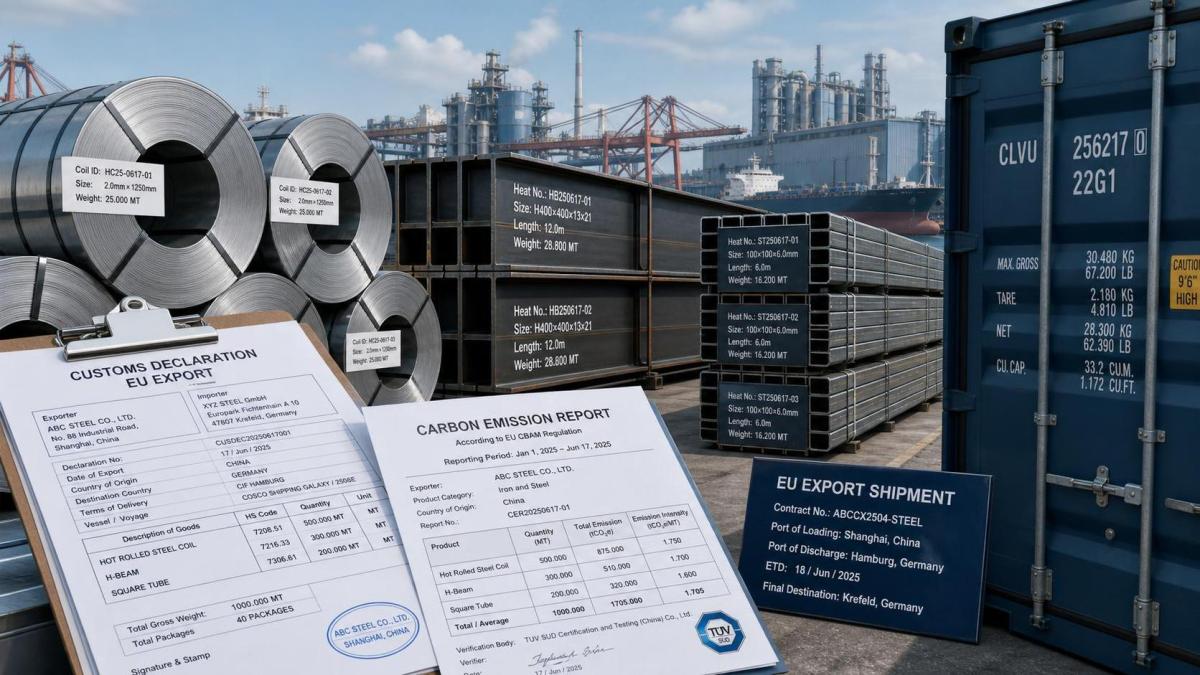
What Has Now Taken Effect
According to the provided event information, from August 1, 2026, the third stage of the EU CBAM transition period is fully activated. All Chinese exporters of steel and structural steel products to the EU are required to complete quarterly reporting of embedded carbon emissions through the EU CBAM portal.
The same information states that exporters must also submit carbon intensity reports verified by an accredited third-party body. If reporting is not completed in compliance with the requirement, customs clearance may be affected, and eligibility for entry into the later formal stage may also be impacted.
The provided summary further confirms that this requirement directly affects supply-chain compliance preparation, cost calculation, and delivery rhythm for global steel exporters.
Where the Pressure Is Likely to Appear First
Export operations now face a documentation and timing test
From an industry perspective, exporters are likely to be the first group to feel the practical effect of this change because the filing obligation sits directly between shipment execution and market access. What deserves closer attention is the combination of quarterly embedded-emissions reporting and third-party-verified carbon intensity documentation, which turns carbon data into part of export readiness rather than a peripheral sustainability matter.
For these companies, the main pressure points are likely to include internal data collection, document completeness, filing coordination, and shipment timing. They will need to pay close attention to whether product-related carbon information, supporting reports, and submission records are prepared in a way that aligns with customs and later-stage access requirements.
Manufacturers and processors may be drawn into upstream data delivery
Analysis shows that processing and manufacturing companies in the steel supply chain may also be affected, even where they are not the direct exporting party. If exporters must submit embedded carbon data and third-party-verified carbon intensity reports, upstream production entities may face greater requests for process-related information, emissions accounting support, and traceable technical records.
The business impact here is less about public policy language and more about operational handoff: whether production-side information can be organized in time, whether it can support verification, and whether it can be matched to exported product batches without delaying commercial execution.
Procurement and supply-chain service providers may need tighter coordination
Observably, procurement teams and supply-chain service providers may need to adjust how they manage supplier readiness, shipment scheduling, and document flow. A requirement tied to quarterly filing and verified carbon intensity reporting can affect when materials are sourced, how orders are consolidated, and whether delivery commitments remain realistic under new compliance steps.
For these participants, attention is likely to shift toward supplier qualification, documentary responsiveness, and coordination between commercial and compliance functions. Even when they are not the filing entity, their work can influence whether exporters meet reporting expectations without disrupting delivery schedules.
What Companies Should Watch Closely Now
Quarterly reporting is becoming a recurring trade task
Analysis shows that companies should treat the quarterly filing obligation as an operational process rather than a one-time regulatory event. The practical issue is not only whether data exists, but whether it can be collected, reviewed, and submitted through the EU CBAM portal within a repeatable reporting rhythm.
Third-party verification will shape document preparedness
What deserves closer attention is the requirement for carbon intensity reports verified by an accredited third-party body. The provided information does not describe the detailed execution standard, so it is more appropriate at this stage to regard verification readiness as a compliance focus that still requires careful monitoring. Companies should therefore pay attention to the completeness, consistency, and traceability of technical and emissions-related materials that may support such verification.
Delivery planning may need to reflect compliance lead time
Observably, the event points to a direct connection between reporting compliance and delivery rhythm. Where filings or supporting reports are incomplete, the risk is not framed only as an administrative issue; it may also affect customs handling and later access conditions. For exporters and their customers, this makes lead-time planning and shipment sequencing a point of practical concern.
Costing models may need a compliance layer
From an industry perspective, the summary clearly links the new requirement to cost calculation. While no specific cost impact is provided, companies should watch whether reporting, verification, and related internal coordination begin to influence quotation assumptions, supplier selection logic, or contract execution pacing.
Why This Should Be Read as an Execution Signal
Analysis shows that this development is better understood as an implementation-stage signal rather than a distant policy discussion. The reason is straightforward: the requirement is tied to an active filing mechanism, a defined reporting cycle, and a stated consequence for non-compliance in customs clearance and later-stage eligibility.
At the same time, it would be premature to present all downstream effects as settled outcomes. Observably, the market still needs to watch how filing practice, verification expectations, and business-side coordination develop in execution. For now, the strongest reading is that carbon compliance for steel exports to the EU is moving deeper into routine trade operations.
How to Read the Current Change Rationally
This event points to a rule change that has moved from policy language into operational compliance for steel-related exports to the EU. Its significance lies in making embedded emissions reporting and verified carbon documentation part of practical trade readiness, with implications for customs handling, supply-chain preparation, and shipment planning.
It is more appropriate to understand this development as a landed compliance change with continuing execution questions, rather than as a fully settled market outcome. Companies connected to steel exports should therefore read it as an active signal to review reporting workflows, document readiness, and coordination across export and production functions.
Basis of This Article and What Still Needs Verification
This article is generated based on the user-provided news title, event date, and event summary. For developments of this type, commonly relevant source categories may include official announcements, regulatory releases, customs or trade authority information, industry association notices, standards-related documents, and reporting by authoritative media.
No specific official source link was provided in the input, so that link still needs to be independently verified in follow-up review. Observably, further attention should remain on detailed implementation language, verification expectations, filing interpretation, changes in tender or technical document requirements, market feedback, and how affected companies carry out compliance in practice.

By clicking 'Allow All', you agree to the storage of cookies on your device to enhance site navigation, analyze site usage and assist with our marketing efforts. Coo Cookie Notice
Please give us a message
SHANDONG LUBAO METAL GROUP CO., LTD.