



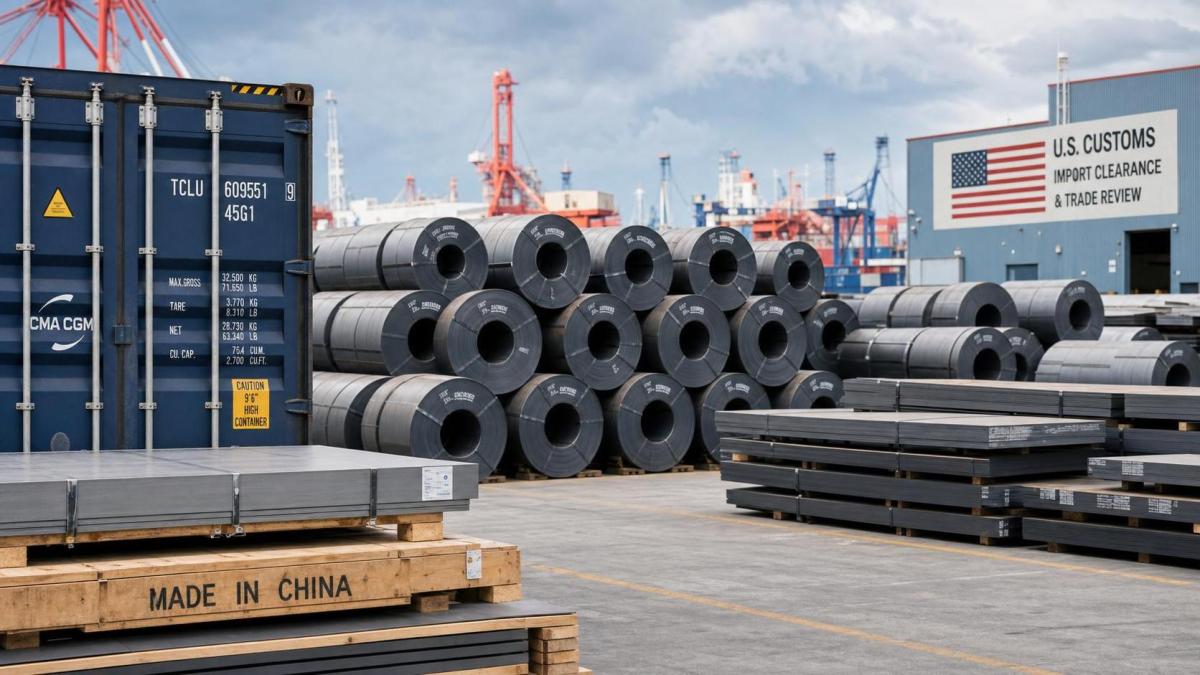
On July 7, 2026, the U.S. Department of Commerce announced an expedited first sunset review of the antidumping duty order covering hot-rolled steel flat products from China. For the steel trade, this is not just a procedural update: it directly affects how exporters, overseas distributors, importers, and downstream buyers assess U.S. market access, landed cost exposure, customs clearance planning, and contract terms tied to future supply.
What Has Been Confirmed So Far
The confirmed facts are limited but commercially significant. The review was initiated by the U.S. Department of Commerce on July 7, 2026, and it concerns the first expedited sunset review of the antidumping duty order on hot-rolled steel flat products from China. The current duty rates under the 2021 determination are stated as 126.42% to 256.44%.
The matter is relevant because the outcome of this review will directly affect market access and compliance costs for exports of this product category to the United States over the next five years. The summary provided also indicates likely implications for overseas distributor customs clearance, importer pricing strategy, and the drafting of procurement contract terms for end buyers.
Where the Pressure May Appear in the Supply Chain
Export decisions become more closely tied to compliance cost visibility
From an industry perspective, exporters dealing in the affected steel category may face a more demanding commercial environment because access to the U.S. market is linked not only to product movement but also to the duty framework under review. The business impact is likely to show up in quotation practices, customer commitment timelines, shipment planning, and the level of caution used when accepting U.S.-bound orders.
What deserves closer attention is the treatment of trade documentation, product scope alignment, and transaction records that support customs and duty-related handling. Even without a new result yet, the review itself raises the importance of document consistency and forward-looking compliance checks.
Importers and distributors may need to rethink pricing and clearance assumptions
Observably, overseas distributors and importers are exposed at the point where duty risk becomes a landed-cost issue. If a review affects the practical outlook for the existing duty order, pricing models, inventory planning, and customs clearance expectations may all need to be reassessed.
The main operational pressure points are likely to include import cost allocation, customer quotation validity, and contract language dealing with duty-related adjustments. Firms in these roles should pay attention to whether their internal review process for customs, product classification support, and commercial terms is strong enough to absorb regulatory uncertainty.
Downstream buyers may feel the effect through contract structure rather than immediate supply loss
For end users and procurement teams, the issue is not limited to raw material price movement. Analysis shows that the more immediate concern may be how supply contracts are written when duty exposure remains commercially relevant over a multi-year horizon. This can affect purchase timing, price adjustment clauses, delivery risk allocation, and supplier evaluation in U.S.-linked transactions.
Companies sourcing affected products should therefore watch not only supplier offers but also the supporting trade and compliance assumptions behind those offers.
What Companies Should Watch Now
Track official wording rather than assume the review outcome
It is more appropriate to understand this stage as an active rule-related development rather than a finished enforcement result. Companies should focus on subsequent official wording, procedural notices, and any clarified execution approach instead of assuming that the practical impact has already been fully settled.
Recheck contract terms tied to duty risk
Because the provided summary specifically points to importer pricing strategy and end-user contract design, firms should review whether current agreements clearly address duty-related cost changes, quotation validity, delivery obligations, and responsibility allocation if trade conditions shift during performance.
Review document readiness for trade and clearance workflows
Analysis shows that this type of review increases the importance of internal control over transaction records, product descriptions, technical documents, and trade paperwork used in cross-border execution. Even where no new execution detail has been provided, businesses should be prepared for closer scrutiny in how commercial and customs-facing materials align.
Adjust procurement and supply planning with caution
For procurement teams and supply chain managers, the practical response is not necessarily immediate restructuring, but more careful planning around lead times, supplier commitments, and exposure to U.S.-linked deliveries. What deserves closer attention is whether current sourcing plans rely on assumptions that may become harder to support if duty-related costs remain a decisive factor.
Why This Looks More Like an Execution Signal Than a Final Outcome
Observably, the key significance of this development is that it signals continued regulatory attention to an existing antidumping framework rather than a newly completed rule change. That matters because the review process itself can shape market behavior before any final commercial adjustment is fully reflected in contracts or shipment decisions.
From an industry perspective, this is better read as a compliance and trade execution signal. It tells market participants to watch how official language, transaction practice, and customer negotiations evolve around the existing duty order. It does not, based on the information provided, justify a firm conclusion beyond that.
How to Read This Development at the Current Stage
At this point, the review should be understood as a material policy and trade signal for companies connected to exports of Chinese hot-rolled steel flat products to the United States. Its relevance lies in future market access conditions, compliance cost exposure, customs handling expectations, and the commercial structure of importer and buyer agreements.
A neutral reading is the most appropriate one here: the event reflects an active regulatory process with direct commercial implications, but the practical path of implementation still requires continued observation rather than assumption.
Basis of This Article and What Still Needs Verification
This article is based on the user-provided news title, event date, and event summary. For developments of this kind, relevant source categories usually include official notices, releases from regulatory authorities, customs or trade administration information, industry association materials, standard-setting documents, and reporting by authoritative media.
No specific official source link was provided in the input, so the exact source document still needs to be verified on an ongoing basis. Further observation is also needed regarding later official wording, execution interpretation, contract practice changes, market feedback, and how affected companies adjust procurement, compliance, and delivery arrangements.

By clicking 'Allow All', you agree to the storage of cookies on your device to enhance site navigation, analyze site usage and assist with our marketing efforts. Coo Cookie Notice
Please give us a message
SHANDONG LUBAO METAL GROUP CO., LTD.