



On July 24, 2026, the EU moved CBAM for steel products into a mandatory reporting stage during the transition period, covering products such as hot-rolled sections, H-beams, and angle steel. For Chinese manufacturers exporting steel and structural sections to the EU, the change is no longer a distant policy signal but an operational requirement tied to customs clearance, future taxation from October 2027, and the way importers, suppliers, and verification parties coordinate shipment data. That is why this development deserves close attention across export, procurement, compliance, and delivery functions.
What the new filing requirement now covers
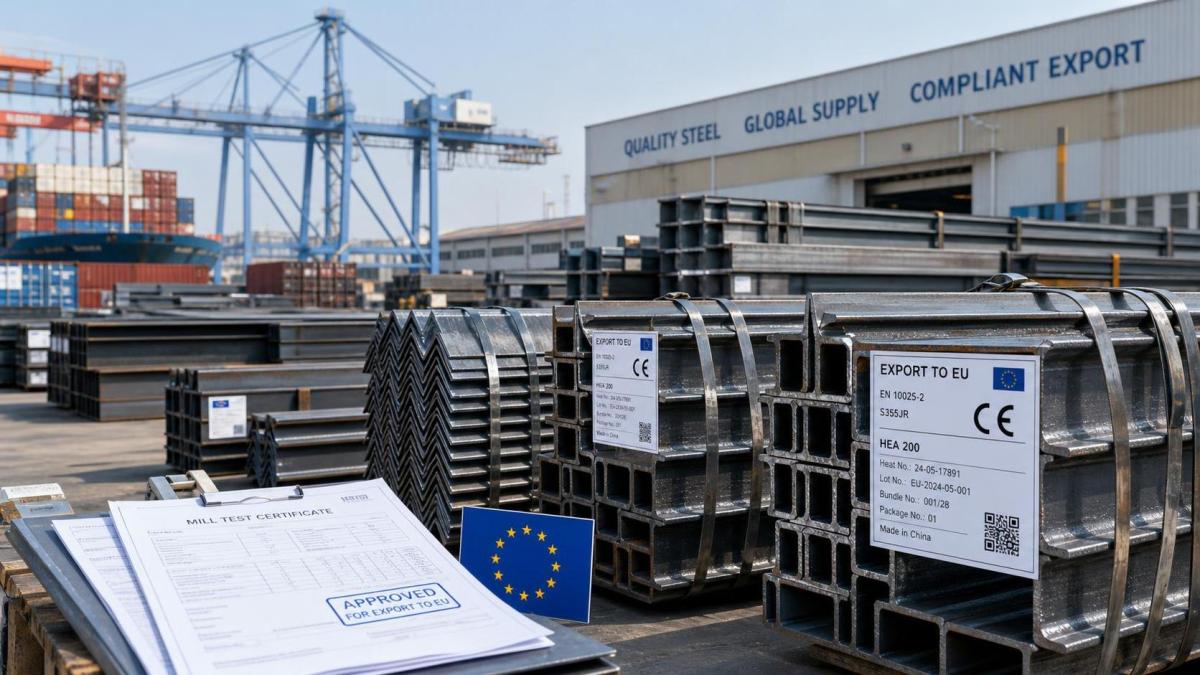
According to the provided information, from July 24, 2026, the EU Carbon Border Adjustment Mechanism (CBAM) began a mandatory reporting phase in its transition period for steel products, including hot-rolled sections, H-beams, and angle steel. Chinese manufacturers exporting steel and steel sections to the EU are required to submit, through the CBAM portal, the embedded carbon emissions of each shipment batch, the production method, and a third-party verification report. The provided information also states that non-compliant reporting may affect customs clearance and later formal taxation starting in October 2027.
Where the pressure will show up in day-to-day trade
Export transactions are becoming document-driven
From an industry perspective, exporters are likely to feel the first impact in shipment preparation. The requirement is tied to batch-level emissions data, production method disclosure, and third-party verification, which means export execution is no longer limited to commercial and logistics documents. What deserves closer attention is whether internal product records, production information, and verification materials can move in step with shipment schedules.
EU buyers will need closer supplier coordination
Observably, overseas importers and procurement teams may face a more structured supplier screening process. The provided information already indicates an effect on procurement procedures, which suggests that supplier communication, document collection, and reporting readiness may become part of purchasing decisions. In practice, this may affect how buyers compare suppliers, confirm batch details, and manage order timing.
Verification and compliance support will move closer to the order cycle
Analysis shows that the reporting obligation may also affect compliance-related service work around steel exports. Because third-party verification reports are part of the required submission set, companies involved in compliance review, document preparation, and related technical support may need to align more closely with production batches and delivery timing rather than treating reporting as a separate back-office task.
Supply chain timing may become more sensitive
The provided information states that the requirement directly affects supply chain coordination efficiency. For manufacturers, traders, and logistics-facing teams, the practical issue is not only whether data exists, but whether it can be assembled, checked, and submitted without slowing customs-related processes. That creates a new interface between production records, trade documentation, and delivery planning.
Operational issues companies should watch now
Readiness of batch-level emissions documentation
Analysis shows that companies shipping covered steel products should pay close attention to whether embedded carbon emissions data can be prepared on a batch basis. This is not yet a conclusion about execution outcomes, but a practical compliance checkpoint because the reporting requirement is tied to each batch rather than a general company-level statement.
Consistency between production method records and submission files
What deserves closer attention is the link between production method information and trade-facing documentation. Where production records, technical files, and reporting submissions are not aligned, exporters and buyers may face additional review friction. The provided information does not define a detailed enforcement practice, so this remains an area to monitor rather than a confirmed outcome.
Timing and cost implications of third-party verification
Observably, the requirement for third-party verification may affect both certification cost and order preparation timing. Companies involved in EU-bound steel shipments should therefore watch how verification work is scheduled against delivery commitments, especially where multiple batches or product types are involved. The current information confirms the requirement itself, but not a uniform market practice for how quickly verification will be completed.
Preparing for the link to future taxation
The provided information clearly connects current reporting compliance with later formal taxation from October 2027. It is more appropriate to understand this as a present compliance stage with forward-looking commercial consequences. For that reason, exporters and buyers should watch not only immediate filing obligations, but also how current reporting quality may influence future tax-related exposure and contract discussions.
Why this reads as an execution signal, not just a policy headline
Analysis shows that this development is better understood as a rule entering operational use rather than a policy concept still sitting at the announcement stage. The filing obligation is attached to specific shipment information, and the consequences mentioned in the provided information reach customs clearance, future taxation, procurement procedures, certification cost, and supply chain coordination. At the same time, it would be premature to treat all downstream effects as settled, because the provided information does not include detailed enforcement practice, market response, or a fuller execution interpretation. Continued observation is still necessary.
How the market may best interpret this stage
At this point, the event is most reasonably read as a concrete compliance threshold for steel exports to the EU, especially for covered sections and structural products. It does not by itself confirm how every importer, exporter, or service provider will adjust, but it does show that emissions disclosure, production-method transparency, and third-party verification are moving closer to routine trade execution. A neutral reading is that the market is now dealing with a live reporting requirement whose practical handling will matter as much as the rule text itself.
Basis of this article and points still requiring verification
This article is based on the user-provided news title, event date, and event summary. For developments of this kind, relevant source types typically include official notices, regulator releases, customs or trade authority information, industry association updates, standards-related documents, and reporting by established professional media. No specific official source link was provided in the input, so the exact official publication path still needs to be verified on an ongoing basis. What also requires continued observation includes implementation details, certification and verification interpretation, changes in tender or procurement documents, market feedback, and how companies are handling reporting in actual export operations.

By clicking 'Allow All', you agree to the storage of cookies on your device to enhance site navigation, analyze site usage and assist with our marketing efforts. Coo Cookie Notice
Please give us a message
SHANDONG LUBAO METAL GROUP CO., LTD.