


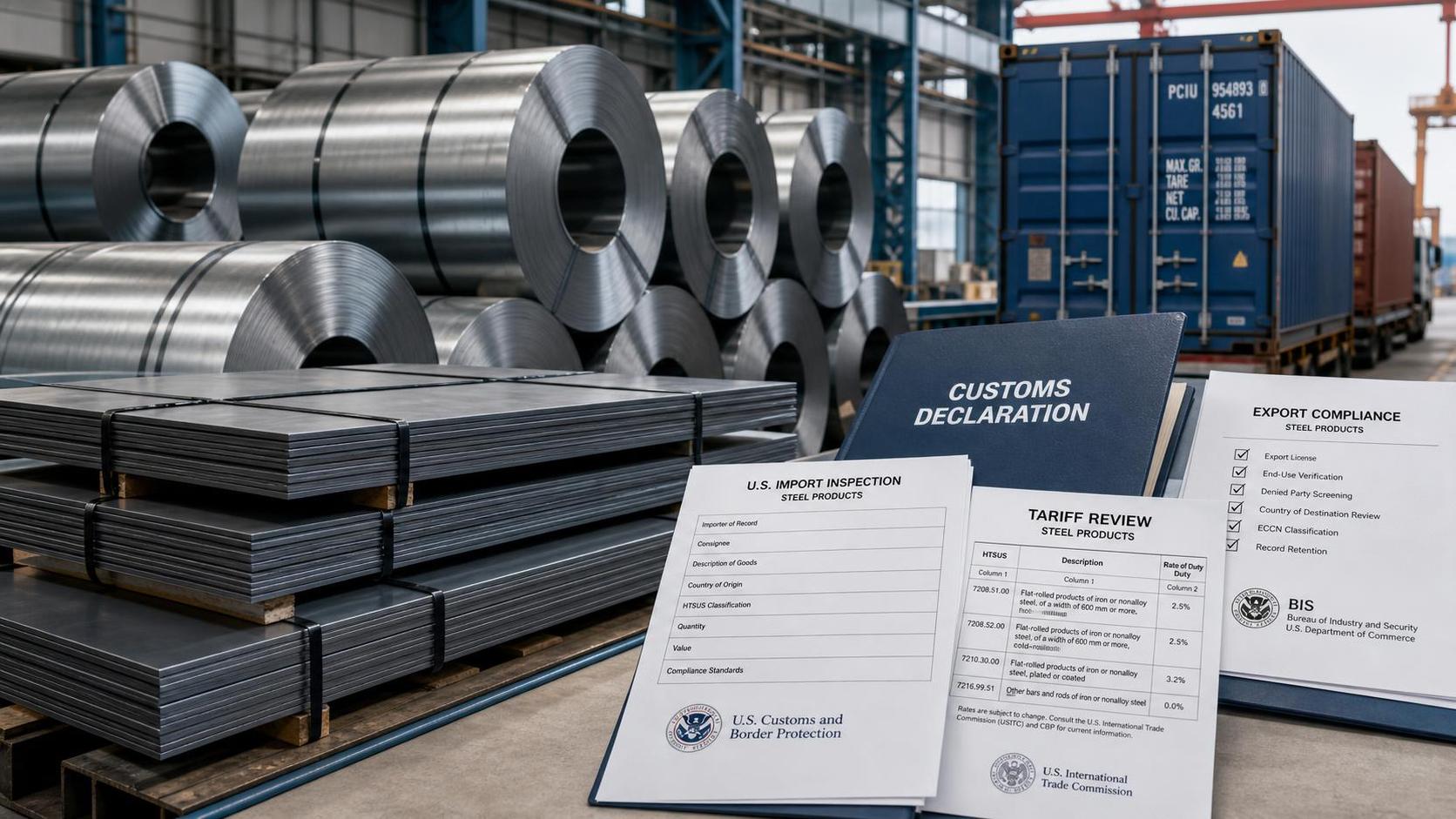
On July 29, 2026, the U.S. Department of Commerce (DOC) announced the launch of the first expedited sunset review of the antidumping duty order on hot-rolled steel strip from China, covering HS 7208.10-7208.99. The notice matters not only to Chinese exporters, but also to U.S.-bound buyers, customs and compliance teams, and supply chain service providers, because the review is tied to future duty treatment, documentation readiness at customs clearance, and procurement-side compliance assessment over the coming five years.

What the DOC has formally initiated
According to the information provided, the DOC has officially opened the first expedited sunset review concerning antidumping duties on hot-rolled steel strip originating in China. The products referenced fall under HS 7208.10-7208.99.
The same notice requires Chinese exporters to submit qualification certifications and cost data within 30 days. The review is described as directly affecting the duty rate application for exports to the United States over the next five years, as well as the completeness of customs clearance documentation and buyers' compliance risk assessment.
Where the pressure may appear across the trade chain
Export quotations may face immediate adjustment pressure
From an industry perspective, direct trading companies are likely to focus first on pricing. Because the review is linked to future duty rate application, export quotations to the U.S. market may need closer internal review, especially where offers, validity periods, and contract assumptions depend on current duty expectations.
Documentation teams may become a key operational checkpoint
For exporters, customs brokers, and supply chain service providers, the issue is not limited to pricing. The notice also highlights qualification certification and cost data, which means document completeness and consistency may become a central operational concern. Any weakness in file preparation could affect customs-facing processes and increase transaction friction.
Buyers and procurement functions may tighten compliance screening
For U.S.-bound buyers and procurement teams, the stated impact on compliance risk assessment is especially relevant. Observably, this may push purchasers to examine supplier documentation, product classification, and transaction records more closely before placing or renewing orders involving the covered HS range.
Processing and downstream planning may need closer coordination
Processing manufacturers and downstream users connected to U.S.-related orders may also need to watch the review. Analysis shows that where delivery schedules, sourcing plans, or customer commitments are tied to exports of the covered products, any uncertainty around duty treatment or paperwork readiness can affect planning decisions even before any longer-term outcome is known.
What companies should monitor now
The 30-day submission window
What deserves closer attention is the immediate filing requirement. Chinese exporters named within the scope of the notice need to track the 30-day deadline for qualification certifications and cost data, because the timing of submission is already part of the practical business impact described in the event summary.
Consistency between pricing and supporting records
Companies involved in quoting or negotiating U.S.-bound business should review whether current commercial assumptions are aligned with the documents and cost information that may be required in the review context. This is less about making a market forecast and more about reducing avoidable discrepancies between transaction terms and compliance materials.
Readiness of customs and shipping files
Since the summary explicitly points to customs clearance document completeness, firms should pay close attention to internal document flow, including the handoff between sales, compliance, logistics, and external service providers. In practice, incomplete or inconsistent files can become a separate source of risk from the tariff issue itself.
Customer communication and risk allocation
For suppliers and buyers already engaged in U.S.-related business, it is also worth distinguishing between the policy signal and the immediate contractual effect. The current development is the start of a review process, but counterparties may still ask for updated compliance materials, clearer responsibility allocation, or revised assumptions in ongoing transactions.
How this development is best understood at this stage
Analysis shows that this is not yet a final commercial outcome, but it is more than a routine headline. The formal start of an expedited sunset review, together with the 30-day filing requirement, signals that exporters and related market participants need to treat compliance preparation and documentation quality as immediate business matters rather than as background legal issues.
It is more appropriate to understand this as a live procedural development with potential medium-term consequences. The event already creates short-term operational pressure around submissions, quotations, and document control, while the longer-term effect on U.S.-bound trade conditions still requires continued observation.
Why the market should keep watching
The industry significance of this update lies in its dual effect: it touches both trade cost expectations and execution discipline. For companies exposed to the covered HS categories, the practical question is not only whether future duty treatment may change, but also whether current files, supplier credentials, and customer-facing compliance materials can withstand closer scrutiny.
At the present stage, the most balanced reading is that this is a consequential review trigger rather than a concluded result. It calls for attention now, particularly in export pricing, customs documentation, and procurement compliance workflows, while final implications still depend on subsequent procedural developments.
Basis of this article and what remains to be verified
This article is based on the user-provided news title, event date, and event summary. For this type of development, relevant source categories typically include official government notices, company disclosures, industry association updates, authoritative media reporting, and trade or standards-related documents.
No specific official source link was provided in the input, so the exact underlying publication should continue to be verified. Follow-up attention should focus on any subsequent official wording, procedural updates, filing-related clarifications, and further details affecting duty application, customs documentation requirements, and buyer-side compliance review.

By clicking 'Allow All', you agree to the storage of cookies on your device to enhance site navigation, analyze site usage and assist with our marketing efforts. Coo Cookie Notice
Please give us a message
SHANDONG LUBAO METAL GROUP CO., LTD.